

It’s July, it’s holiday season in Belfast and the city is full of tourists. This July I’ve decided to be a ‘tourist’ in my own city and explore the city in ways that are new to me. Last week I took part in the ‘Linenopolis’ tour which is a guided walking tour of Belfast’s linen heritage. I thought I’d share some of the tour with you which gives a fascinating insight into this significant period in Belfast’s history.
‘Linenopolis’
During the 1800s Belfast and its surrounding towns exploded with industry – shipbuilding, ropemaking and linen. In time, Belfast became known as Linenopolis, in the same way as Manchester became known as Cottonopolis. The import and export of linen became a major trade for the city. Indeed, in 1900, approximately 900,000 spindles were running in Belfast alone, more than in any country in the world.
The ‘Linenopolis’ walking tour
The ‘Linenopolis’ walking tour, run by the Linenhall Library, is a 90 minute leisurely walk around Belfast’s linen quarter which is right in the centre of the city. It takes you on a journey into Belfast’s past, learning about the people and the places that were central to the industry’s success.
The starting point
The starting point for the guided tour is the reception at the Linenhall Library which was once itself a linen warehouse. Established in 1788, it is the oldest library in Belfast. You need to be a member to use the facilities. However, you can certainly take a wander round for free and admire the beautiful architecture. There is a tea room too. It’s closed at the moment but I believe it is due to reopen soon under new management.
The Linenhall Library


The City Hall
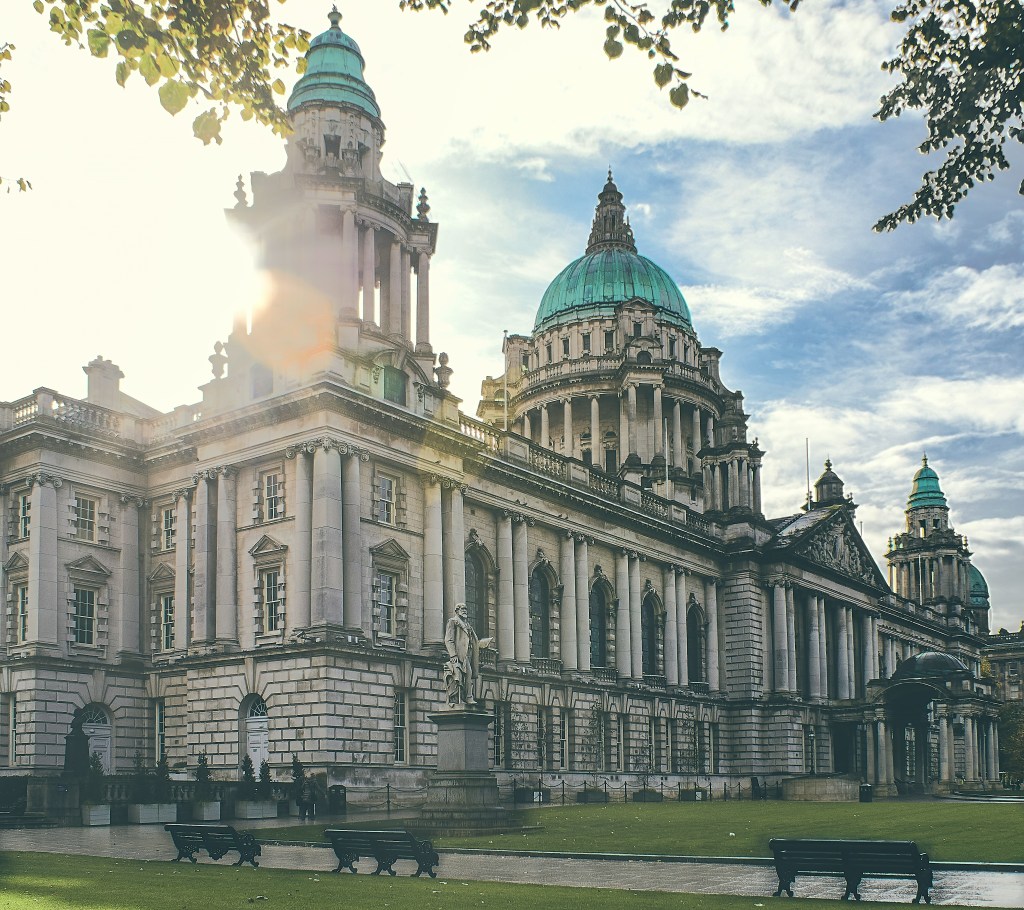
Next stop is the City Hall, undoubtedly the most impressive building in Belfast’s city centre. This was originally the site of the White Linen Hall where merchants would bring their linen to be graded and sealed as a mark of quality. The City Hall was completed in 1906 after Queen Victoria granted Belfast ‘city’ status in 1888. It replaced the White Linen Hall as a civic space.
Belfast’s City Hall, (photo by K. Mitch Hodge on Unsplash)
Here you will also find new (and long overdue) statues in memory of two women.
The first, Winifred Carney, was a suffragiste and campaigner for the ‘Linen Slaves of Belfast’ , mostly women and children who worked long hours in horrific conditions in the linen mills. The second, Mary Ann McCracken, was an abolitionist and social reformer.
On the left, Winifred Carney, on the right Mary Ann McCracken


The streets of the Linen Quarter
From the City Hall it is a short walk into the maze of streets that make up the core of the Linen Quarter. You’ll find lots of old linen warehouses, some now used as offices and restaurants, others lying derelict which is a pity really as they have so much potential.
In Bedford street you will find Ewarts warehouse. Ewarts was the largest linen company in the world at this time and they had many warehouses and mills across Northern Ireland. The warehouse in Bedford street is a beautiful sandstone building and was used for linen finishing, marketing and administration. Indeed my late mum worked there in the 1960s on the first floor doing ‘ornamenting’ – making up presentation packs of linen tablecloths and napkins. She was always telling me how much she loved that job. In recent years, the warehouse has been restored and is now partially occupied by Deloitte. Quite a change in use really !
Ewarts Warehouse


Scenes from the streets in Belfast’s Linen Quarter


Back to City Hall
The last 10 mins of the walking tour bring you back to the City Hall. You pass the Titanic Memorial Garden located inside the grounds of the City Hall. The garden was opened in 2012 to mark the 100th anniversary of the sinking of the Titanic. It’s always a poignant place to visit.
From this vantage point you can also observe the Robinson and Cleaver building which was an upmarket department store selling high class linen amongst other things. The department store has sadly followed the same fate as many others and has long since closed. However, the beautiful building remains and is now home to one of my favourite restaurants Cafe Parisien.
The Robinson and Cleaver building, ( I took this photo a few years ago)

Cafe Parisien in the Robinson and Cleaver Building

All in all, I really enjoyed this walking tour of Linenopolis which cost just £10. I haven’t covered it all here but I hope it gives you a taste of what to expect. The guide was well informed. You could ask as many questions as you wanted and we walked at a leisurely pace for the 90 minutes or so. Everyone else on the tour seemed enthusiastic, keen to learn about this period in Belfast’s history. Although linen production here is no longer the great industry it once was, the streets and beautiful buildings that endure to this day are a great legacy to be enjoyed by locals and visitors alike.
Have a lovely Sunday,
Paula
Useful Links
To buy tickets for the Linenopolis tour and for info on the Linenhall library – click here
Other posts from Typewriter Girl to enjoy:-
My magnolia moment in Queen’s Quarter, Belfast
Belfast really does have some beautiful old buildings. Love the Linen Library. X
Thank you. The library is my favourite too !
Another spot added to the book!
Lol. It must be quite a big book by now!